
ENFORCEMENT OF FOREIGN JUDGMENTS ON COMMERCIAL MATTERS IN GREECE
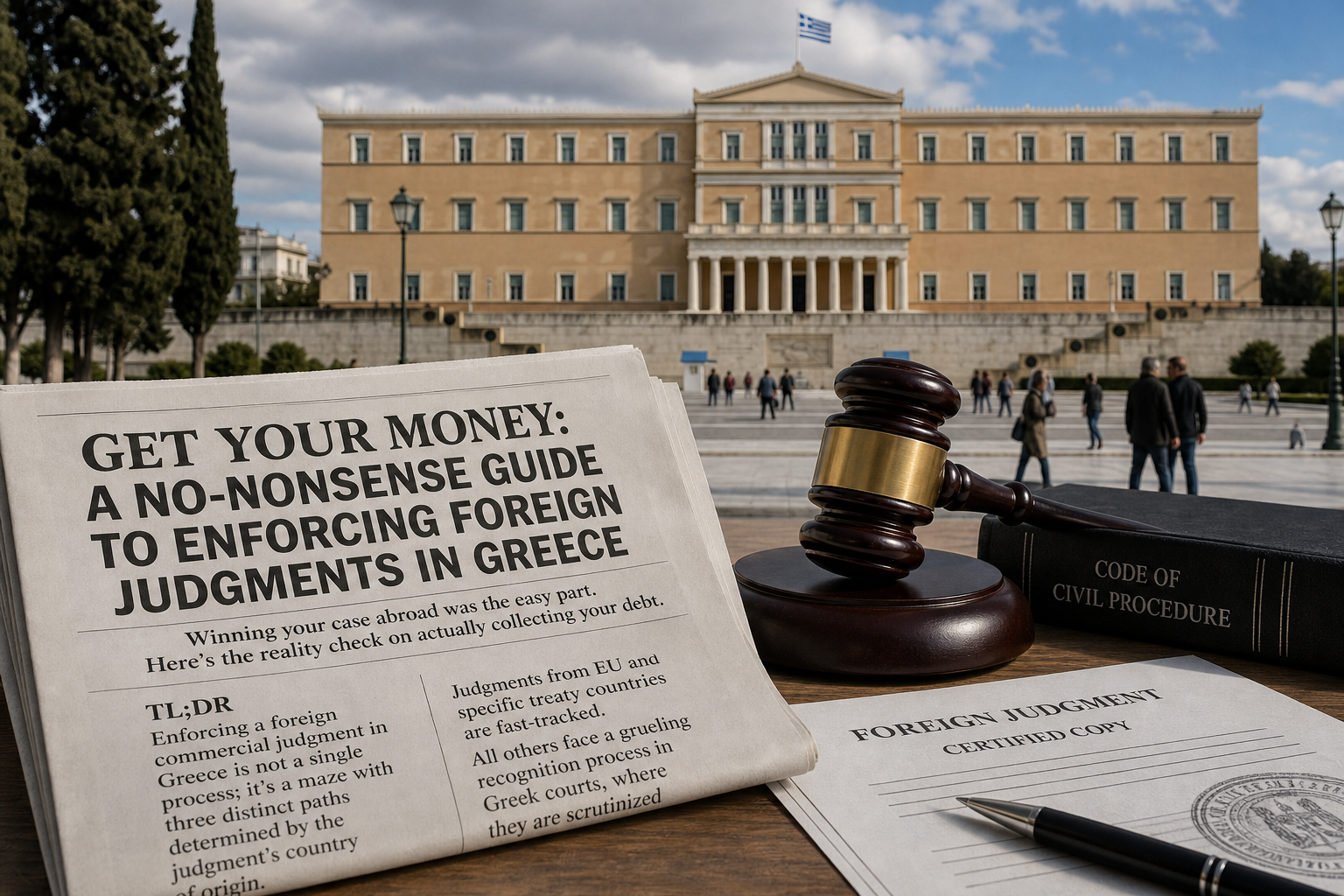
Get Your Money: A No-Nonsense Guide to Enforcing Foreign Judgments in Greece
Winning your case abroad was the easy part. Here’s the reality check on actually collecting your debt.
TL;DR
Enforcing a foreign commercial judgment in Greece is not a single process; it’s a maze with three distinct paths determined by the judgment’s country of origin. Judgments from EU and specific treaty countries are fast-tracked. All others face a grueling recognition process in Greek courts, where they are scrutinized with a scalpel. Before you do anything, a reality check is non-negotiable: confirm the debtor has assets worth chasing.
A court victory abroad is just expensive wallpaper until you can convert it into cash. The Greek system can be a fortress of bureaucracy, designed to frustrate and delay. But for every wall, there is a gate. You just need the right key and a map that cuts through the political noise and procedural somersaults.
Key Takeaways
- Origin is Everything: Where the judgment was issued dictates the entire enforcement process. An EU verdict is not the same as one from China.
- The Three Paths: Your case will follow one of three routes: the Treaty Highway (e.g., USA), the EU Express (most EU members), or the Bureaucratic Swamp (everyone else).
- Asset Tracing First: Do not spend a single euro on enforcement until you have confirmed the debtor has seizable assets in Greece. A judgment against an empty shell is a pyrrhic victory.
- “Public Order” is the Veto: For non-EU/non-treaty judgments, the Greek courts can reject enforcement if the ruling offends local “public order”—a vague but powerful tool for obstruction.
## Step Zero: Don’t Chase Ghosts
Before diving into legal proceedings, the first step is a brutal reality check. There is zero point in pursuing enforcement if the debtor has no assets. This is the absolute prerequisite.
We must surgically ascertain:
- What assets does the debtor possess? (Real estate, bank accounts, equipment, shares)
- What is their estimated value?
- What is the probability of a full or partial recovery?
- How long will the process take and what are the associated costs?
Chasing an insolvent debtor is a fool’s errand. We deal with data, not hope.
## The Crucial Question: Where Was Your Judgment Issued?
Greek law doesn’t treat all foreign judgments equally. The origin of your court order determines whether you are on a modern highway or a winding dirt road. This is the most critical factor.
### Path 1: The Fast Lane – Bilateral Treaties
If your judgment originates from a country with which Greece has a specific enforcement treaty—such as the USA, Germany, or Ukraine—you are in the strongest position. These treaties are designed to slice through red tape.
- Mechanism: These international treaties prevail over both EU and Greek domestic law, as per Article 28 of the Greek Constitution.
- Process: There is no need for recognition by a Greek court. The process is direct and swift.
- The foreign judgment, bearing the Hague Apostille, is served to the debtor.
- An executory mandate is attached, demanding voluntary compliance.
- The debtor has three working days to pay. If they fail, compulsory enforcement measures begin immediately.
This is the cleanest, most efficient path. It is a surgical strike.
### Path 2: The EU Express – Regulation 1215/2012
Judgments from any EU member state (with the exception of Denmark) are enforced under the EU Regulation No. 1215/2012. The principle is simple: a judgment enforceable in one member state is enforceable in all.
- Mechanism: The judgment is treated “as is,” without any special recognition procedure. This is the core of the EU’s single market for justice.
- The Debtor’s Last Stand: A debtor can file an objection, but their grounds are extremely limited. They cannot re-argue the substance of the case. Their only hope is to prove a narrow procedural flaw, such as:
- The judgment is irreconcilable with an earlier, recognized judgment.
- The judgment violates exclusive jurisdiction rules under the Regulation.
These are the last-ditch legal somersaults of a cornered debtor, and they are typically easy to dismantle with proper evidence.
- Process: You serve the debtor with the original judgment (or a certified copy), a standard certificate from Article 53 of the Regulation, and official translations. After three working days, enforcement can commence.
- Critical Exception: This regulation does not apply to bankruptcy rulings. Those judgments are thrown back into the complexities of domestic Greek law.
### Path 3: The Hard Road – Full Recognition by Greek Courts
If your judgment comes from a country not covered by a treaty or the EU Regulation (e.g., China, Russia, the UK post-Brexit), you must prepare for a formal battle in a Greek court. Your judgment has no legal force until a Greek judge declares it enforceable.
This is a two-stage examination process.
#### Stage 1: Basic Requirements for Any Foreign Title
First, the foreign title (be it a court order, arbitral award, or notarial act) must satisfy two fundamental conditions:
- It must be enforceable in the country where it was issued.
- It must not violate Greek public order or boni mores (good morals). This is a notoriously vague and subjective standard that can be used to block judgments deemed incompatible with Greece’s core legal and social principles.
#### Stage 2: Additional Scrutiny for Court Judgments
If the foreign title is a court judgment, it must survive three additional tests with a scalpel, as laid out in the Greek Code of Civil Procedure (Article 323):
- Proper Jurisdiction: The foreign court must have been competent to hear the case according to Greek conflict-of-law rules.
- Right to a Fair Trial: The losing party must not have been deprived of their right to be heard and participate in the trial. “Gotcha” judgments are rejected.
- No Contradiction: The judgment cannot be irreconcilable with a prior judgment from a Greek court between the same parties on the same issue.
Only after clearing all these hurdles will the Greek court grant an exequatur (a declaration of enforceability).
## The Endgame: Seizing Assets
Once your foreign judgment has been declared enforceable—whether through the streamlined treaty/EU paths or the grueling court recognition process—it becomes a domestic Greek judgment.
From this point on, the procedure is standardized. We can deploy the full arsenal of domestic enforcement measures, including:
- Foreclosure and auction of real estate.
- Seizure of bank accounts.
- Confiscation of movable property (vehicles, equipment).
This is the final objective: converting your legal victory into tangible assets.
## Stop Wasting Time. Secure Your Claim.
You have a valid judgment. Don’t let it expire in a bureaucratic purgatory of procedural tricks and intentional delays. The law provides clear pathways to enforcement, but navigating them requires precision and a refusal to tolerate nonsense.
Contact us to cut through the red tape and enforce what is rightfully yours.